by Walt Stoner
April 11, 1970, marked the fiftieth anniversary of rapid transit service in the City of Shaker Heights. The Shaker Rapid, first known at the Cleveland Interurban Railroad, is now a part of the Greater Cleveland Regional Transit Authority. On April 11, 1920, heavily modified streetcar #1203 made the first trip on the Moreland line, and thus the first run of a rapid transit car in Cleveland and Shaker Heights.
To help Shaker Heights celebrate this occasion, our museum planned two events. On Saturday evening, April 11, a four-hour movie and slide program depicting the past of the Shaker Rapid was held. The next day, at 12:45 pm, two hundred people showed up at the Shaker Rapid station under the Cleveland Union Terminal for a six-hour trolley excursion over the Shaker and Cleveland rapid transit lines. The first trip was to Windermere (CTS) with a three-car train of Shaker PCC cars. After returning to the Terminal the three-car train of 1200s (including Shaker’s original rapid car, #1203) was boarded along with an extra PCC to handle the overflow for a second trip to Windermere. It is believed that on these two trips, more Shaker PCCs were run over the Cleveland Transit System line to Windermere than in the entire previous history of the CTS. Throughout the rest of the afternoon, the three-car train and the PCC ran several trips over the Shaker lines.
The Shaker 50th anniversary trip was one of thirteen fantrips and excursions that the museum sponsored throughout the decade. Some excursions were simple fantrips, chartering a car on the Shaker and CTS rapid systems or at Trolleyville for an afternoon. Equipment usually included Shaker car #12 but at various times included a Cleveland/Toronto PCC that had been returned to the Shaker rapid under RTA, the two Illinois Traction PCCs #450 and #451 that RTA borrowed from other museums, and RTA’s bicentennial PCC car #76. And not all fantrips were run during the day. On September 26, 1970, we chartered the Shaker Rapid from midnight to 6 am. We had the whole line to ourselves! Some excursions were a little more elaborate running at both Trolleyville and the rapid systems with a movie night in between. And then we did a two-day trip to Toronto, visiting Halton County Radial Railway Museum and chartering one of Toronto’s Tour Trams (sisters to our TTC #2778). We visited Halton County Radial on Saturday afternoon, left Saturday evening open so the people could explore Toronto on their own, then rode the Tour Tram during the day on Sunday and topped off the trip with a stop at a buffet in New York. Now add ten hours on a bus and you have a very busy weekend. Fantrip and excursions kept us very busy and were a major source of funds.
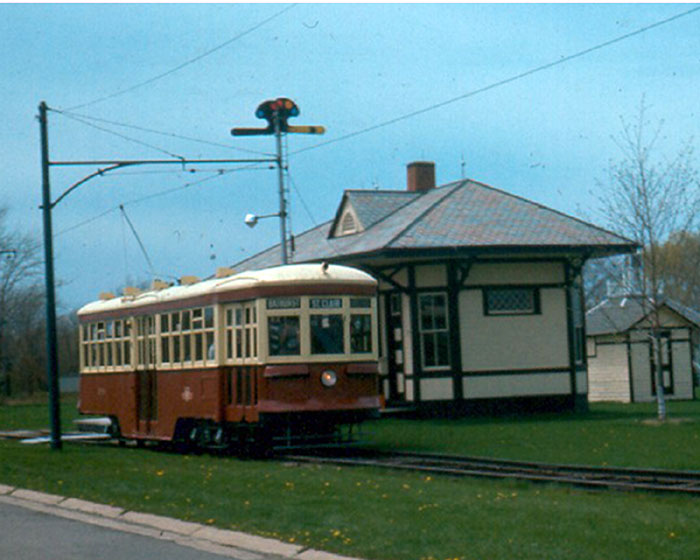
When we weren’t running fantrips, we were pursuing the museum’s goals: to collect, preserve, restore, display and operate streetcars. At the beginning of 1970, we had three cars: NOT&L #1510 was at Trolleyville, SHRT #1203 was in Shaker’s Kingsbury yard and TTC #2778 was still up in Toronto. In the early 1970s correct trucks were obtained for #1510 and work on the body continued. #1203 was maintained for fantrips on the Shaker and CTS rapid transits. We had TTC regauge #2778 and it was just waiting to be moved to Ohio. A combination of lack of funds and the hope that a permanent home would be found kept us from bringing the car to Ohio until 1974. At that time, TTC wanted it off their property. Red and I talked to Gerry Brookins, and he agreed to let us move the car to Trolleyville. This led to one of the most complex (and expensive) car moves the museum has ever made. TTC loaded #2778 on a railroad flatcar in Toronto which was shipped to Cleveland via Buffalo. The car eventually worked its way out to Olmsted Falls where it was transferred to a lowboy trailer using two cranes, it was then moved to Trolleyville. There the two cranes again lifted #2778, the lowboy was pulled out from under it and the car was set down onto Trolleyville’s track. The total cost of the move was $3,320 (about $22,900 in today’s dollars).
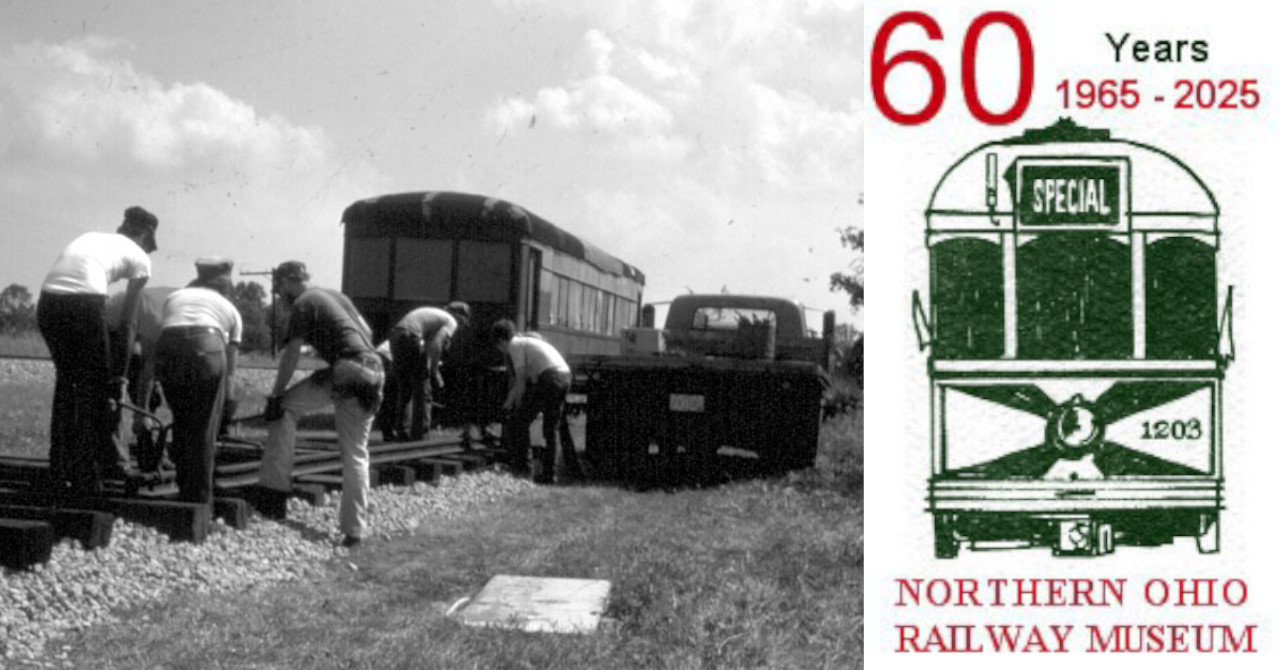
We just about got our tools put away from moving #2778 when Shaker, as part of their cleanup of Kingsbury yard, told us to get #1203 off their property. Once again, we talked to Gerry Brookins and he agreed to let us bring #1203 to Trolleyville. We were pretty much broke after the #2778 move, so the #1203 move had to be done “on the cheap” as Red would say. “On the cheap” meant a lot of manual labor. Back in the 1950s when the Cleveland streetcars were being scrapped, one scrapper did most of the car moving. We contacted him and found that he still had the dolly and fifth wheel plate he used in the 1950s, so we rented them. Lifting a streetcar off its trucks and setting it onto a dolly and a fifth wheel plate turns the carbody into a semi-trailer. Lifting a streetcar off its trucks and setting it onto a dolly and a fifth wheel plate requires either a big crane or a lot of jacking. We opted for the latter. We did hire a small crane to load and unload the trucks. Once #1203 arrived at Trolleyville, we again used jacks to put the car back on its trucks. We managed to move this car for $730. It’s amazing how much money volunteer labor can save.
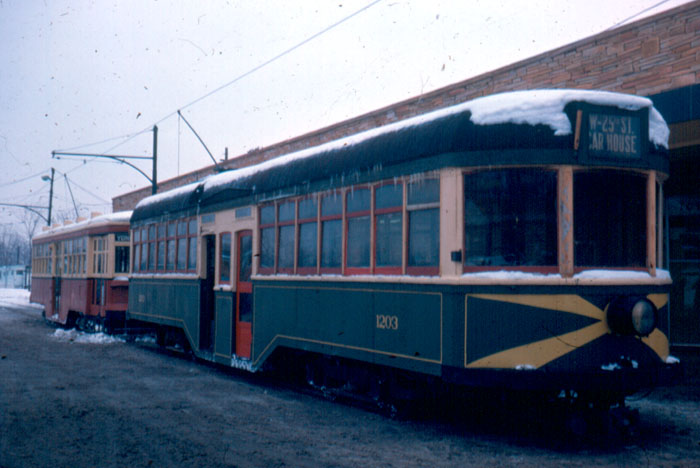
For the next few years, we had a good relationship with Trolleyville. We did some minor work on #2778 and got it running by 1975. In 1975 and 1976 we held a number of charters at Trolleyville. At each event we featured our two cars with rides on #2778 and had our gift shop set up in #1203. While at Trolleyville we purchased our fourth car, Pittsburgh Railways snow sweeper #M30. The car was owned by a private collector and was already at Trolleyville.
Finding a permanent home had been a goal of the museum since its beginning. In the mid-1970s, N.O.R.M. Trustee Tim Lassan took on the task of finding us a home. His perseverance paid off when a possible site was found in 1976. The museum had long established the criteria for a permanent home. It had to be former interurban right of way, near Cleveland, with easy access to a freeway and adjacent land available for carbarns and public facilities.

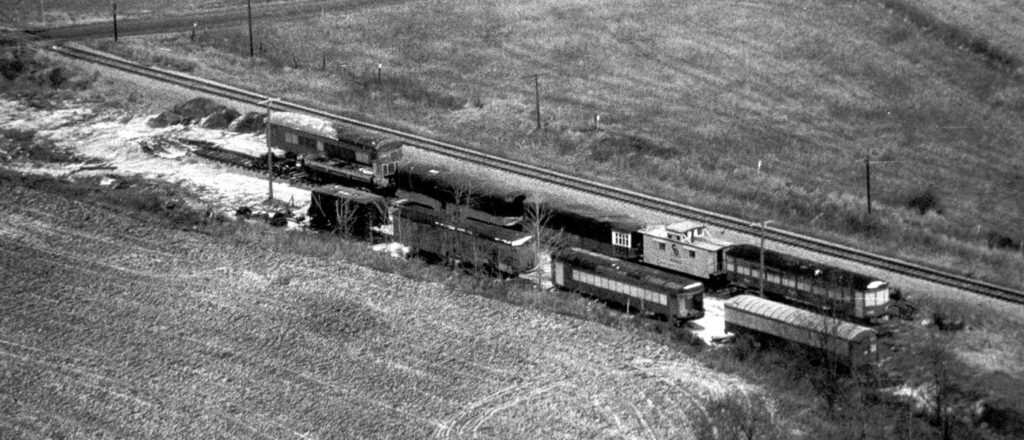
This location met or exceeded those criteria. It was former Cleveland, Southwestern and Columbus interurban right of way. It was about fifty miles from Cleveland Public Square, and it was close to the interchange between two Interstate highways, I-71 and I-76. Adjacent land was available but would be obtained in this decade. The property was two miles long and forty to fifty feet wide. In June of 1977 the museum took procession to the property. Our first need was to clear out an area where we could move our present car collection. Later that fall, the museum obtained two Cincinnati and Lake Erie interurban car bodies. The body of C&LE #105 was the first to be moved to the new property, C&LE #101 the second. For a number of years, the south side of Buffham Road would be our home.
The 1970s were filled with firsts. Our first land. Our first rail. Our first track. Regular membership meetings began in December 1976. In 1978 we held our first annual dinner and business meeting. Our first annual picnic was held in 1979. Also of significance, the museum was incorporated as an Ohio not for profit corporation in April of 1976.
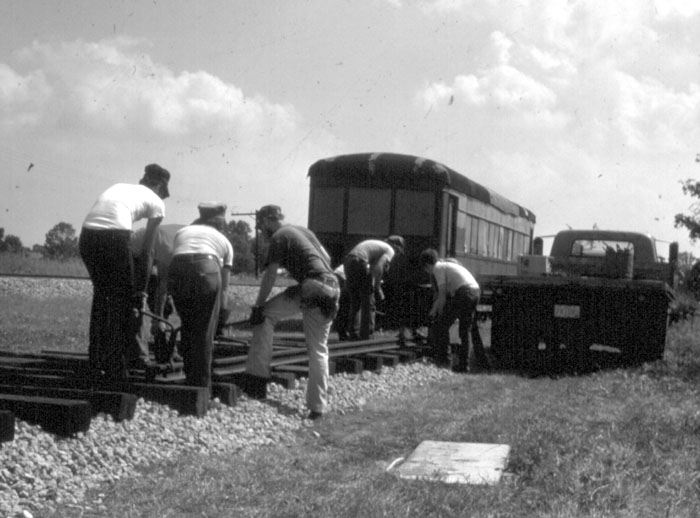
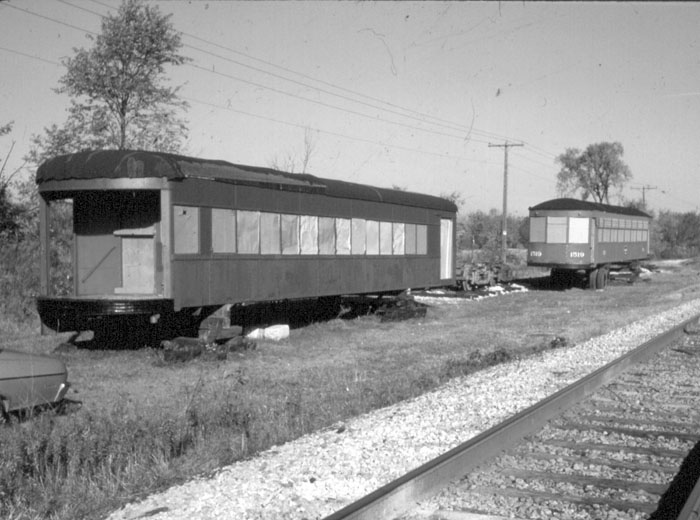
In 1978 and 1979 we began our exodus from Trolleyville. NOT&L #1510 was moved to our new site in 1978. In 1978 we also purchased a second car from that series, #1519. Due to vandalism occurring at the new site in its early years, #1519 was moved to a storage track in the village of Chippewa Lake. 1979 was a very busy year. We moved our remaining three cars from Trolleyville plus we obtained four additional cars. Moving #M30 was a bit of a job because it was stored off track and had sunk into the ground. After a lot of tugging with a dump truck, it reluctantly crawled up a small ramp and onto a lowboy trailer. A piece of wide gauge track had been built at the museum to store the car. Moving#M30 from the trailer to the storage track went a lot easier. Cars #2778 and #1203 were moved on a drop deck trailer. Rail was laid on the trailer and a rail ramp was built from Trolleyville’s parking lot up to the trailer. A large dump truck, using about 300 feet of cable and a couple of large pullies as a block and tackle was used to pull the cars up the ramp and onto the trailer. At the museum, the process was reversed with the dump truck acting as a brake to keep the cars from going down the ramp too fast.

The four additional cars that came in 1979 each had their own story. C&O caboose #90960 was donated to the museum by the president of the company that owned the Terminal Tower at that time. He had obtained the caboose with the idea of making it into a hide away under the terminal. Rumor of the Sohio building (now named 200 Public Square) being built on Huron Road changed his plans and the caboose was donated. Every car move has its challenges. For this car, it was getting it out from under the Terminal and then moving a sixteen-foot-high load down country roads in Medina County. The second car was the body of Lake Shore Electric freight trailer #464 that resided in the middle of a pig farm. The farmer would fill the car with feed for the pigs and just shovel it out to feed them. We moved this car using a dolly and fifth wheel plate as described above. As I recall it was a rather uneventful move. The third car was Chicago Transit Authority elevated car #4423. It was moved by rail, on its own wheels, from Chicago to a siding in the village of Chippewa Lake. The fourth car was Differential dump car #0518 from the CTS Rapid. The challenge with this car is that we actually bought both #0518 and #0516. We scrapped #0516 at Kingsbury, its trucks are now under C&LE #105. #0518 was moved much as #2778 and #1203 were. A rail ramp was built at Kingsbury and the car pulled up the ramp and onto a lowboy trailer. At the museum the process was reversed, but instead of building a rail ramp up to the trailer, we dug a ramp in the ground at the end of the track for the trailer to back down into, aligning the rails on the trailer with the rails in our track. The date of the move was December 31, 1979. When #0518 rolled off the trailer, so too the 1970s rolled away.
So, what was the most significant thing to occur in this second decade? I think that you will all agree that it would be getting a home of our own.
| By the Numbers | 1979 |
|---|---|
| Members | 157 |
| Cars/Carbodies 11 | 11 |
| Land (acres) 10 | 10 |
| Track (total) | 300 feet |
| Track (operating) | 0 |
| Overhead Wire | 0 |
| Buildings 0 | 0 |
| Net Worth | $31,666 |