
by Walt Stoner
As the 1990s began the Museum owned a two-mile section of the former Cleveland, Southwestern and Columbus Railway interurban right-of-way, located between Chippewa Lake and Seville. It also owned an adjacent thirty-acre parcel on the north side of Buffham Road. Most of the Museum’s trolley collection was stored on the right-of-way just south of Buffham Road. Twelve PCC and rapid transit cars were stored on the western edge of the adjacent property. Another seven cars were stored on a CSX siding about a mile north of the Museum and a caboose was being stored on a member’s farm in Litchfield. Lastly, three former CTS service trucks were stored on another member’s farm in Sharon Center. The challenge of the 1990s was to bring it all together.
There were several tasks, started near the end of the 1980s, that would be completed in the early years of the 1990s. These included building a fence across the front of the adjacent property. We had a vandalism problem in the storage area south of Buffham Road ever since we acquired the property. We were hoping to avoid this kind of problem on the north side. I talked to a neighbor who was a deputy sheriff, and he strongly suggested that we put up the fence. At eleven hundred feet, with two gates, this was not a small task, but we did get it completed in 1990. Another task was the grading for a track that would tie the track on the south side of Buffham Road with the track on the adjacent property. This too was completed in 1990. Lastly the legal battle with a former director to get his buses off the property dragged on until 1991. The result was that all buses not owned by the museum were removed and the former director paid all costs.
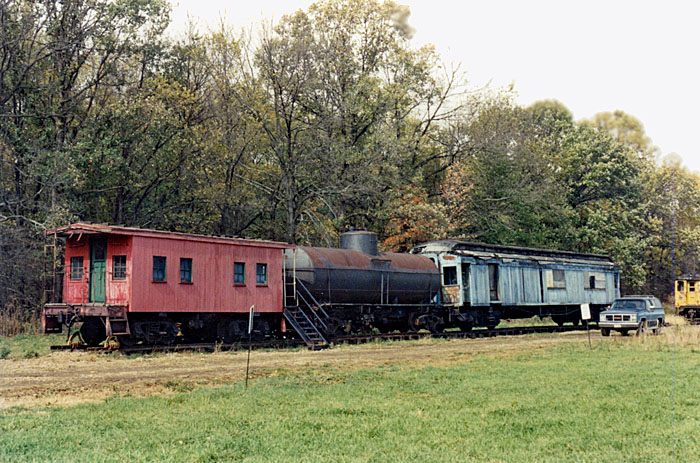
One of the first major tasks of the 1990s was dealing with the seven cars on the nearby CSX siding. Even though the museum’s property parallels the CSX, there is no track connection between the two. The cars would need to be trucked that last mile. The Museum first had to decide what to do with the equipment. Included in the seven cars were a wooden railroad combine, a Pittsburgh & Shawmut caboose, a tank car, a Chicago L car and three Philadelphia subway cars. In 1984 one of our members offered the Museum a B&O transfer caboose. Because we were concerned about vandalism at the museum, we made arrangements to store it at another member’s property. As we were preparing to move the cars from the CSX siding, the second member asked that we remove the caboose from his property. So, it too had to be moved. It was about this time that the museum met Brian Mayer. Brian was a one-man company who did work for the museum well into the 2000s. He could move cars, scrap cars and remove track. He would hire temporary workers as needed to get a job done.
It was decided that the combine, the tank car, the L car and the B&O caboose would be moved to the museum. The P&S caboose had been heavily damaged by vandals in the 1980s and was sold to a private party. Two of the subway cars would be stripped for parts and the bodies scrapped. The third was sold to another private party, who asked that we store it at the museum for a while. During 1991 and 1992, with the help of Brian Mayer we moved six cars to the museum and salvaged parts from two others that were later scrapped. These were some of the shortest truck moves we ever made. In 1991, the line trucks and auger truck were moved to the museum. By the end of 1992, all of our equipment was finally all in one location.
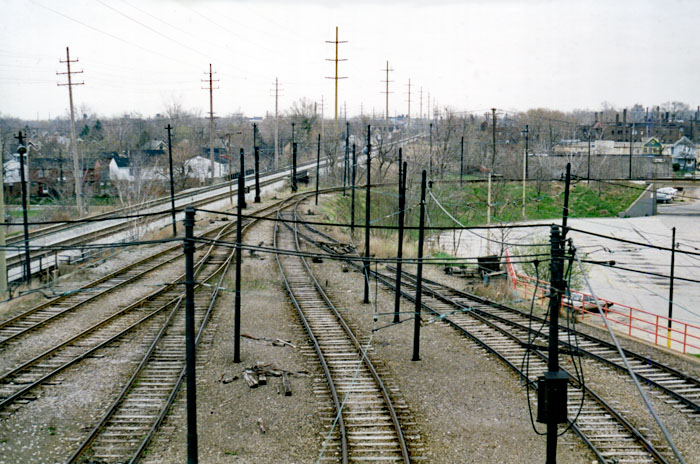
Sometime in the early 1990s, the Ohio Legislature ruled under ORC 306.43, that the Greater Cleveland RTA can make scrap materials available to organizations involved in the preservation of transit and historical items. This means that RTA could offer their surplus items to preservation groups like N.O.R.M. before sending them out for scrap bids. This couldn’t have come at a better time. RTA had just announced that they were planning to remove their service facilities and yard from Windermere, and we were trying to figure out a way to get some of it donated to the museum. Ironically, it was RTA that told us about the new legislation. With their blessing, we spent most of 1995 and 1996 disassembling and removing surplus track materials and shop equipment, and trucking it down to the museum. Track material included 100 pieces of 90# ARA-A rail, 10 switches and 800 ties. Shop equipment included pit rails and supports, truck transfer tables, truck turntables, air conditioners, a 30 KW motor-generator, fare boxes and much more.
RTA also shut down most of its car shop at Brookpark. Among other things, this is where all of the spare parts for the St Louis and Airporter rapid cars were stored. Most of these parts were given to the museum in 1998. In all, four semi-trailer loads of parts were moved to the museum. RTA also gave us the interchange track that ran between the old Erie Railroad and Kingsbury shops. About 3.000 feet of 90# ARA-B rail and matching bars and plates were acquired here. On more than one occasion, large lots of ties were also offered. In addition to the track material from Windermere and the Erie interchange, sidings from three other locations were donated to the museum. These included tracks from Berea in 1991, Wickliffe in 1994 and the Cleveland flats, in 1995. In all, enough material for about 1,500 feet of track was acquired.
We also built a lot of new track in the 1990s. In 1990 Medina County made improvements to Kennard Road at the CSX crossing. The project manager was aware of the CS&C right-of-way and the museum and invited us to install our crossing while the road was torn up. Working with the county saved us a lot of money.
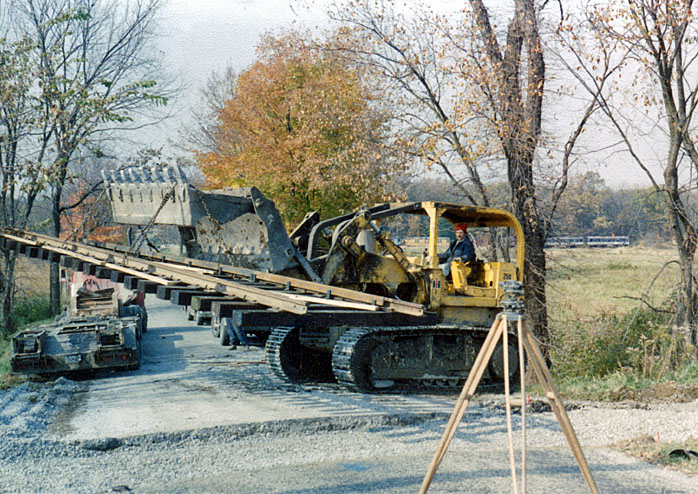
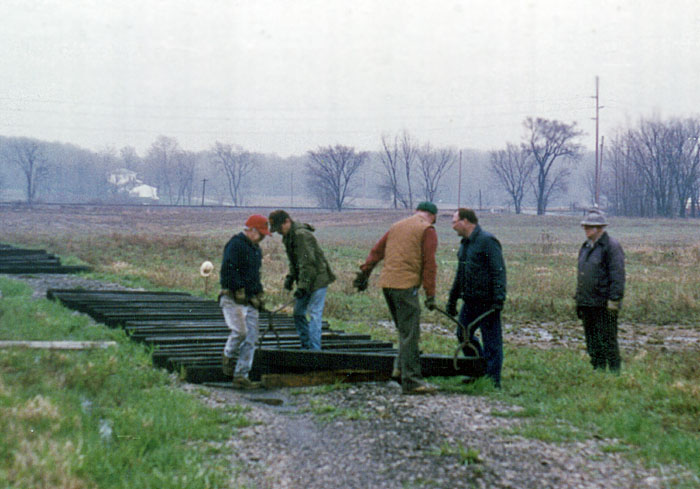
In 1992, we installed the crossing at Buffham Road. For this one, the cost was all on us. Our biggest track project in the 1990s was the construction of a track that ran across the main property and connected the siding on the west side of the main property with the Buffham Road crossing and the track on the south side of Buffham Road. This project was started in 1993 and finished in 1999. It consisted of about 1,100 feet of track which included four switches and two curves.
In 1992 the W&LE offered the museum its depot in Lodi. It was a nice size building that would have made a nice visitor center. The problem is that it just came at the wrong time. Our priority at that time was track and moving the depot would have taken all of our resources, both money and volunteer time. Plus, it was questionable if we could even move it out of Lodi. Some years later the Lodi Railroad Museum acquired the building and has a nice depot museum there today. In 1994, the museum did put up its first building (not counting the outhouse that we put up in the 1980s) on the main property. One of our members had disassembled a one-car garage and reassembled it at the museum. It was big enough to give protection to our tractor and a few tools.
In 1981 the museum acquired and disassembled a 40 by 120-foot Quonset building. Ever since that time, it was assumed that this would be the museum’s first carbarn. It would have held four cars. In 1994 when a second 40 by 40-foot Quonset building was offered, we accepted it and disassembled that building too. The planned size of the first carbarn didn’t change, the additional material would have been used to replace bad parts in the first building. By about mid-1995 however, the overall attitude towards the Quonset buildings was changing. Maybe more of us were seeing the piles of forty-five-year-old used building parts as just piles of scrap metal. Discussions about a carbarn led to the design of a larger building, 50 by 180 feet. The type of building and who would build it was still to be determined. In late 1995 I sent out requests for bids to about thirty companies. Six responded. Most were pole building dealers. Bids ranged from $30,000 for a pole building kit to $120,000 for a finished steel frame building. We zeroed in on two bids, one from a local farm store and one from Chief Agricultural Buildings. As it turned out, the farm store wanted to sell us a Chief building. So, between the farm store and Chief and us, we came up with a final design, 52 by 180 feet, for $70,000. It would hold nine cars with lots of workspace.
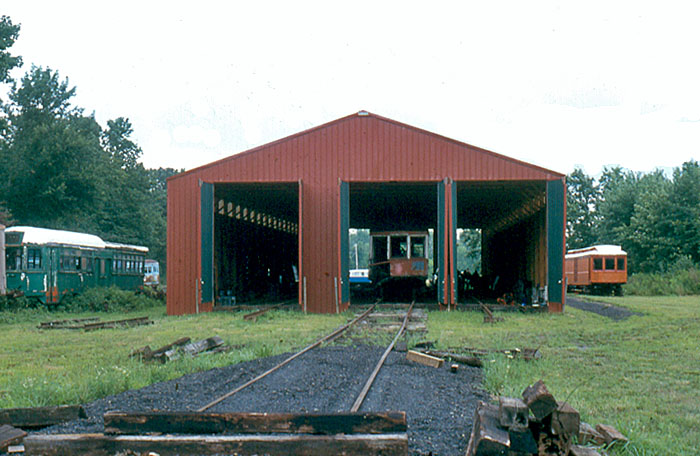
1995 turned into 1996 and our efforts turned to funding the building. We began fund raising with a goal of raising one-third of the cost. In May of 1996 we went to the bank for a loan for the rest. We were pretty much debt free. The loan for the main property had been paid off in 1994. A new loan was approved that July. The building was ordered, but construction did not begin until February of 1997 due to a bad winter. By late spring, we had our first carbarn. One of the first things we did was to name it the Anson W. Bennett Carhouse, after N.O.R.M. co-founder Red Bennett. What we had was a big empty building with two-foot openings under the doors. Throughout the rest of 1997 and 1998 we built a plywood platform along the west wall, laid the three tracks and filled in under the doors. While some grading was done on the outside, tracks leading into the building were not built until the next decade.
At the beginning of the 1990s we had forty-six cars. We acquired five new pieces and disposed of nine, leaving us with forty-two at the end of 1999. Acquired were the body of Shaker greaser car 031, the body of LSE freight motor 42, the body of LSE 151, Ohio Edison flat car 100 and Pennsylvania RR work car 499309. Shaker 031 had been stripped out by RTA with many of the parts going to Seashore Trolley Museum’s beautifully restored Cleveland 1227. The body was sold to an antique dealer in Medina who no longer wanted the car. LSE 42 had been used as a farm building in Sandusky. LSE 151 came to us from the Grand Rapids Electric Railway Museum in Grand Rapids, Ohio. The Ohio Edison flat had been used to carry around a large transformer, much like a portable sub-station. The Pennsy work car was also a gift from Grand Rapids. Cars disposed of were, Pittsburgh & Shawmut wood caboose 165 that was destroyed by vandals in the late 1980s and sold to a private collector in 1991. Shaker wrecker car 11 was destroyed by vandals in 1998 and was scrapped. B&O transfer caboose C496 was returned to its original owner in 1998 who moved it to the B&O Railroad Museum. The GE 25-ton locomotive was sold in 1992. Two of the Philadelphia subway cars, 124 and 70, were scrapped in 1991. Three of the Cleveland, Southwestern & Columbus freight bodies were damaged by a storm and scrapped in 1997.
An interesting side note, LSE 151 was the first car into the new carbarn. This despite there being no tracks connected to the carbarn. The center track was extended out the back of the carbarn and the track filled with stone up to the railheads. The trailer carrying the body of LSE 151 was backed over the new track. A crane lifted the car body, the trailer was pulled out and a set of trucks were rolled under the car. The car was lowered on to the trucks, and six of us pushed the car into the carbarn by hand.
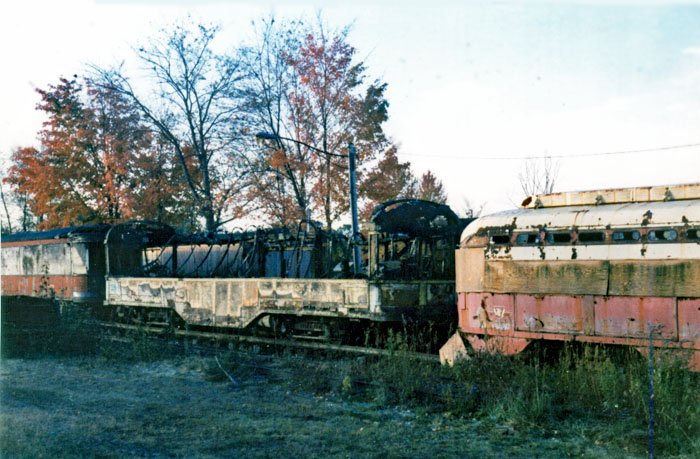
The decade was a mix of good times and bad times. The low point of the decade was the vandalism of our cars on the south side of Buffham Road on October 22, 1997. In all, two cars were destroyed, Shaker wrecker 11 and Pittsburgh snow sweeper M-30. Two cars were damaged, TTC 2778 and TTC PCC 4656. Several other cars had paint damage. Unfortunately, the vandals were never caught.
On the good side we ran three fantrips; to Pittsburgh in 1992 and two with CTS rapid car 109 in 1997 and 1999. Media Nights were offered the first Friday of each month, annual picnics were offered each summer and annual meeting each spring. By the end of the decade, the problems from the end of the 1980s were resolved and we had our first carbarn.
I think you will all agree that the most significant thing to occur in the 1990s was the building of our first carbarn.
| By the Numbers | 1999 |
|---|---|
| Members | 178 |
| Cars/Carbodies | 42 |
| Land (acres) | 40 |
| Track (total) | 3600 feet |
| Track (operating) | 0 |
| Overhead Wire | 0 |
| Buildings (permanent) | 1 |
| Net Worth | $417,012 |