Back in the day, streetcar lines often seemed to run everywhere in a city. Even if they didn’t go quite that far, the did go a lot of places. This meant that lines often crossed and/or joined one another. Track through these crossings and connections was known as “special work,” because that’s exactly what it was. Tracks had to be specially configured at these places, conforming to the unique layouts of the streets on which they were to be laid and to the intended routings of the cars that were to run on them.
Thus, constructing special work often was a complicated business where standard parts could not be employed, and every piece had to be specially made to fill a specific role. To avoid tying up the streets more than necessary, careful measurements were taken and the special work was laid out at a site other than the street. Once it had been fully fitted together to ensure that everything was in order, it would be disassembled and then reassembled in its new home in the street.
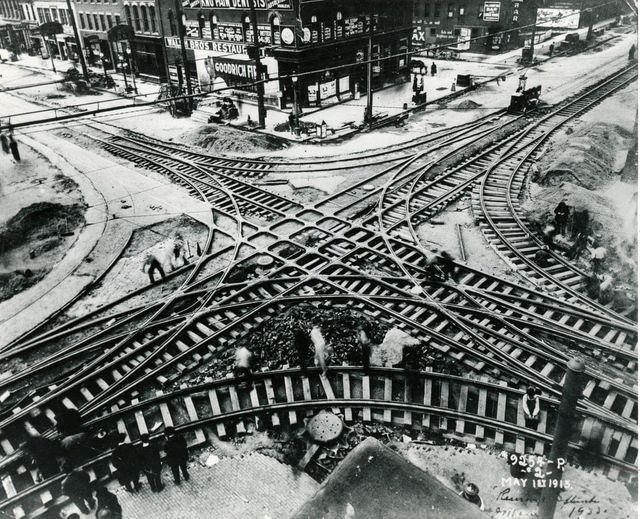
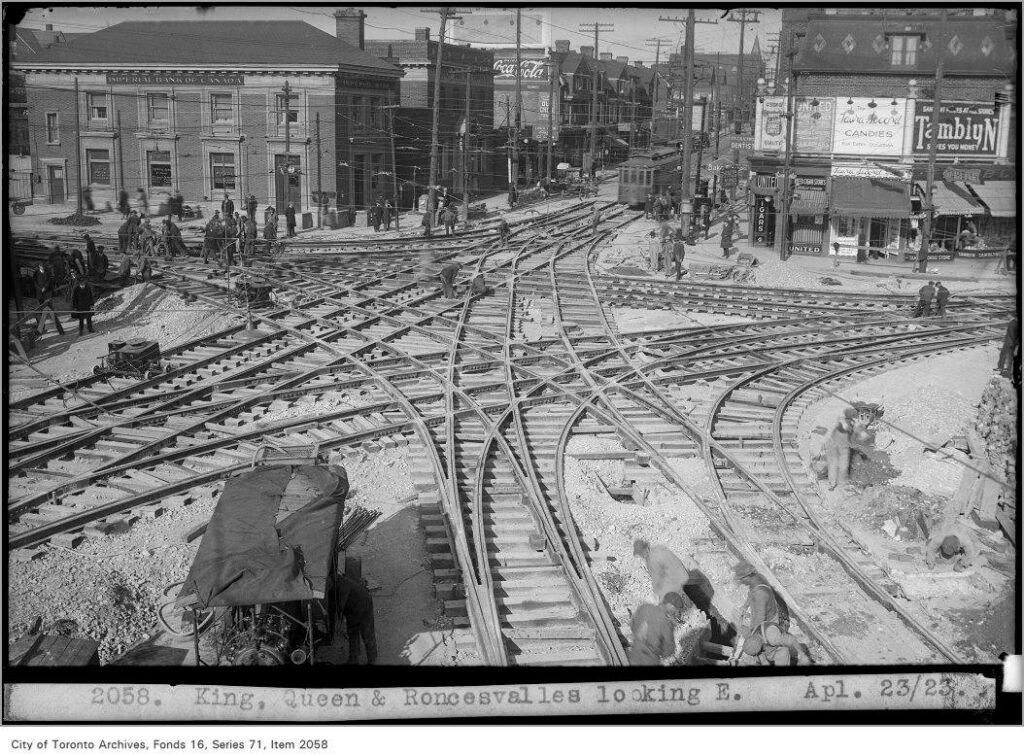
Picture 1, showing construction of the junction at Main and Mill Streets in Akron in 1915, gives a sense of how complex special work could be. In some cases, it might be even more so, as in picture 2 from Toronto!