by Walt Stoner
Well, we made it to 2000—guess we all survived Y2K. In 2000 the museum received a bequest from the estate of Rowan Prunkard, a member who died in 1998. Throughout 1999 we were in contact with the attorneys handling the estate and were informed that we would receive 5% of a $2 million-dollar estate. In 2000 we received payments totaling $97,935. This was the largest donation the museum had ever received, and our board of directors wanted to be sure that we used it wisely. A couple of special meetings were held and it was decided that the money would be used as follows: $33,000 would be used to reduce the balance on our building loan, $28,000 would be used to build a small building for our internal combustion equipment, $27,000 would be used for the purchase of equipment to make our work easier and $10,000 would be deposited into our savings account.
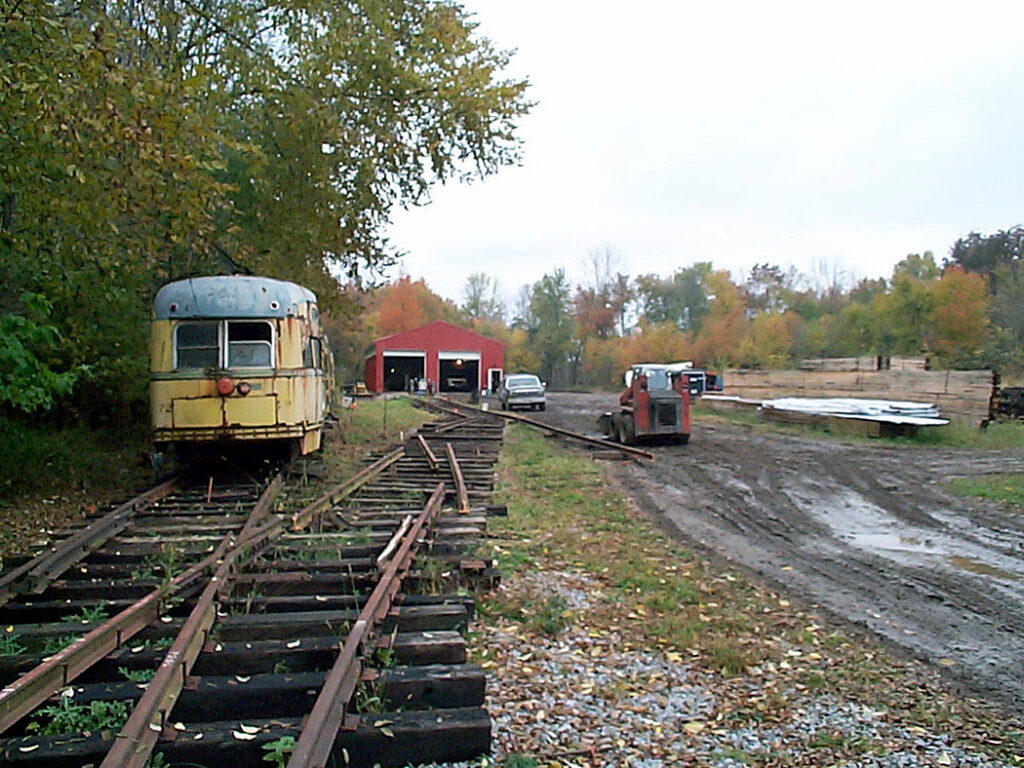
Reducing the balance on our building loan by $33,000 saved the museum thousands of dollars in interest. When we built the Bennett Carhouse in 1997, one track was left only half finished so that we could park trucks and a tractor in the building. Other rubber-tired equipment was sitting outside in the weather. We needed a small building to protect the equipment that we needed to build the museum. A 36 by 72-foot building was selected. It had two large roll-up doors and would have a track on one side so that track maintenance equipment could be serviced. The building cost $26,475 and was named the Rowan S. Prunkard Maintenance Facility. The museum purchased a skid loader, a small dozer, a hi-rail dump truck and three pieces of track equipment: a spiker, a spike remover and a tie inserter. The total cost for the equipment was $20,386. The remaining $18,000 was deposited into our savings account. It is amazing how one generous gift helped in so many ways.
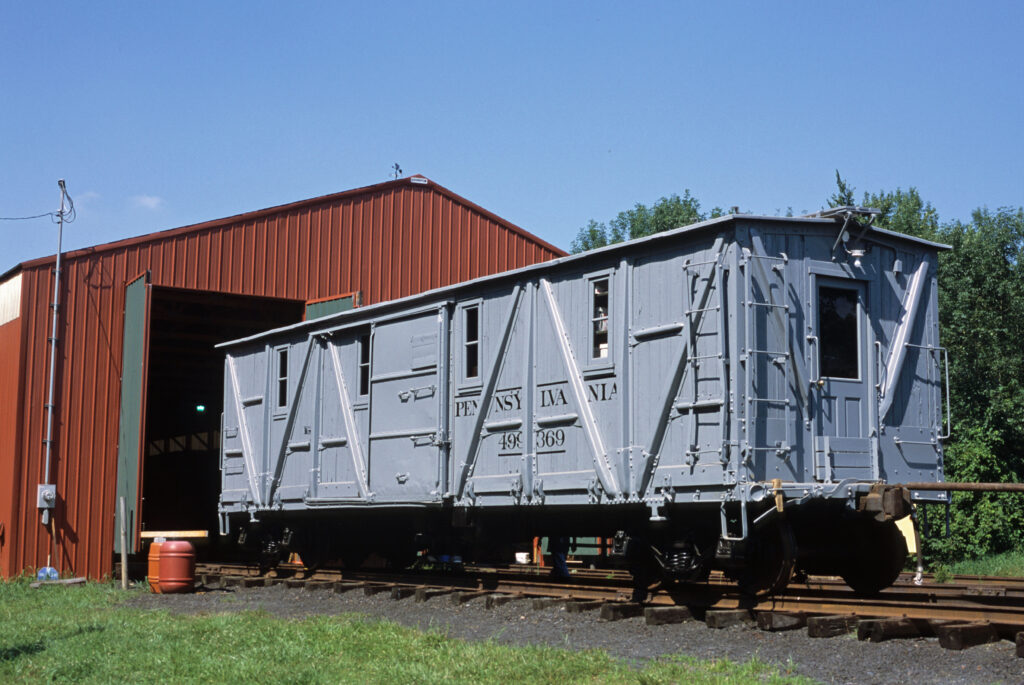
The title of this chapter is More Growth. The “more growth” came as assets acquired from two Ohio railroad museums that went out of business: The Grand Rapids Electric Railway (formerly the Waterfront Electric Railway) and the Lake Shore Electric Railway Museum (formerly Trolleyville U.S.A.). Equipment from Grand Rapids began arriving in 1999 and continued for the next five years. In all, we received eight pieces of rail equipment. Weekly, one or two truckloads of ties, rail, track hardware and signal equipment would arrive. Also, received were a small stake truck and a loader/backhoe. The eight pieces of rail equipment and the year received are as follows: LSE wooden coach 151 (1999), PRR MofW boxcar 499309 (2000), Toledo Railway and Light Co. semi convertible 588 (2001), IC flatcar 70573 (2004), Chicago Rapid Transit 4267 (2005), Detroit & Toledo Shore Line wooden boxcar 419217 (2005), Lorain Street Railway 83 (2005) and Toledo Edison steeple cab locomotive 2 (2005).
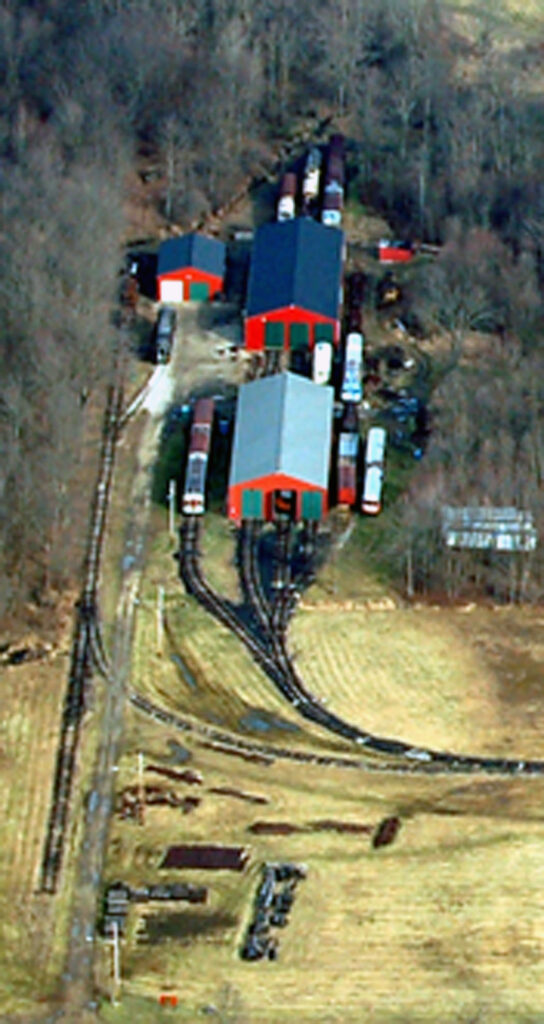
Part of our agreement with Grand Rapid’s Charlie Sheets was that we would build a second carbarn to hold all of the new equipment. Through a combination of fund raisings and new loans, we paid off the mortgage on the first carbarn and financed a second identical building in 2002. Due to a number of changes in the 2002 Ohio Building Code, the cost of the second carbarn was almost double that of the first. Building inspections dragged the completion date out to 2005. But we got it done and most of the equipment from Grand Rapids was under cover. In about an eight-year period, the museum had gone from no buildings to three. About the time that the second carbarn was completed, long time member Fr. John McCarthy passed away. From the start of our first carbarn, he had been a strong supporter of getting our collection under cover. In his will he left the museum $56,222, all of which was used to pay down the mortgage on the second carbarn. As our way of saying thank you, the second carbarn was named the Fr. John R. McCarthy Carhouse.

crane had to rescue it. Jim Smith photo
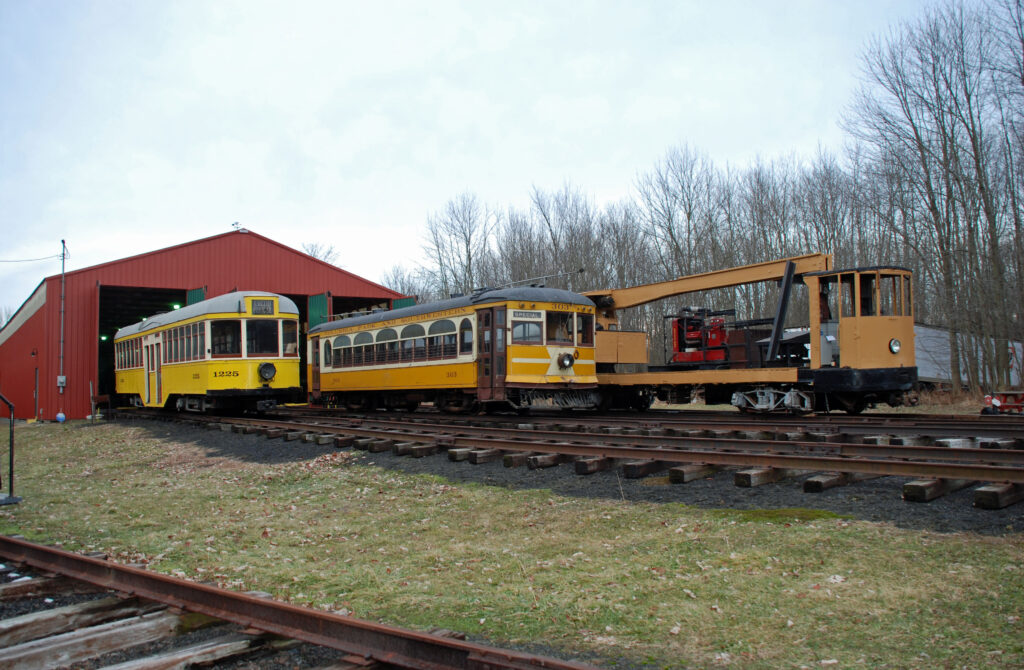
We had just about absorbed everything from Grand Rapids when the assets from the Lake Shore Electric Railway Museum became available. In early 2009, the Brookins Family made the decision to sell off the Gerald Brookins collection. Various proposals were put forth throughout the year, but the final proposal boiled down to the collection would be purchased by a consortium of fifteen museums. Bill Wall, of Shoreline Trolley Museum, led the group. Our museum’s share included five cars, substation equipment, shop equipment, display cases and cabinets, rare trucks and a 1/15th share of the vast collection of Trolleyville’s parts. The five cars included N&W caboose 518021, CTS Airporter 172, Shaker Rapid center entrance car 25, (painted as Cleveland Railway 1225), Shaker Rapid small interurban 303, and Shaker Rapid freight motor 0X. The first four were moved in 2009, 0X was moved in 2010. Despite the year of planning, most all of the moves were made in the October 26 to December 30 time frame. Steve Heister wrote a great article for the Nov-Dec 2009 newsletter. This one paragraph pretty much sums up those two months:
“The Main Event. It could also be called the hell weeks, that crazy time, or the age of exhaustion. No matter what you call it, it marked the most intense period of work in the museum’s history. Over the years, a lot has been accomplished at the museum, but not in such a short period of time. The time frame covered here is from October 26th to December 30, with the week of November 30th to December 5th being the most intense.”
There were over 300 pallets of car parts divided up among the participants. By October 26th, all of the pallets now belonged to one museum or another. But….and a big but….some of those pallets contained missing parts for cars purchased by a different museum. So, while all of the pallets were still laid out on the floor, we all went around picking out the parts that were specific to the cars we had purchased. The museum acquired two semi-trailers which were used to haul our share of the parts back to our museum. During the first couple of weeks of November there was a steady flow of parts and materials from downtown Cleveland out to our museum. The first cars to arrive at our museum were PCC cars that had been purchased by other museums for their trucks. Being the nearest museum, we tried to help other museums where we could. Rather than moving the PCCs all over the country, they asked if they could move them to our museum for scrapping. We obliged. The PCC cars were followed by the N&W caboose. This was also the time when shop equipment and store fixtures were moved.
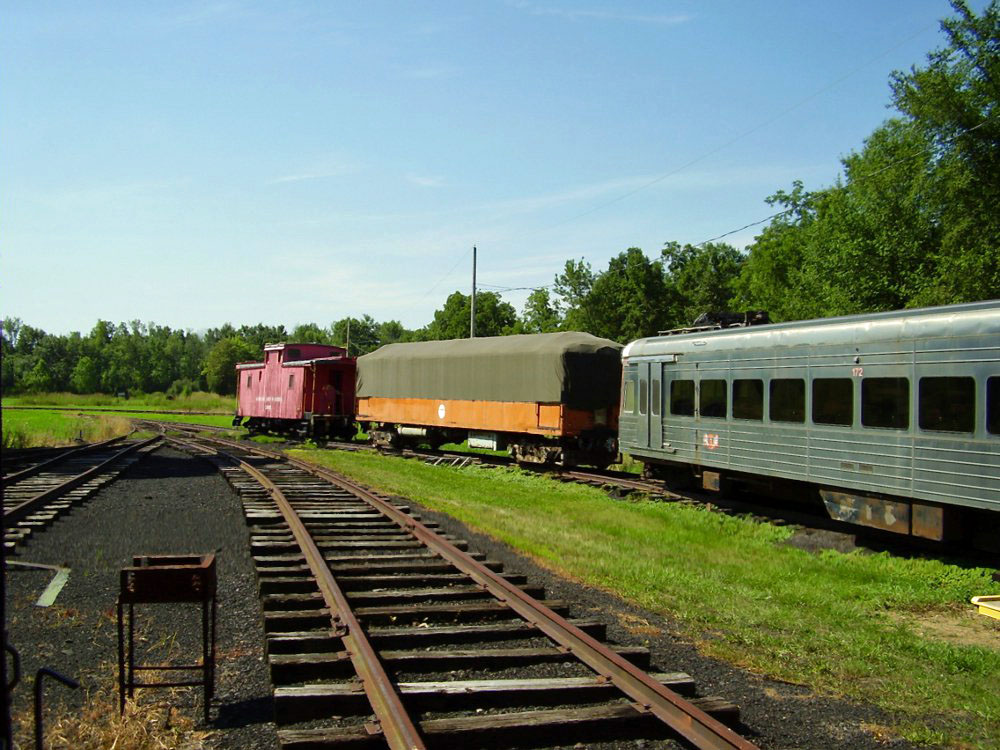
Hell week. On November 30th CTS Airporter 172 began its trip down to the museum. It stayed overnight at a lot in Hinckley and arrived at the museum the next day. This was a classic dolly move. The trucks were removed, and one truck was replaced with a rubber-tired dolly, the other end was hooked up to a big tow-truck. The Airporter’s trucks were moved on a small trailer. It made it as far as the museum’s entrance and got stuck. Also on December 1st, a trailer load of rail was moved. On December 2nd, Shaker 303 was moved to the museum. On December 3rd Shaker 25 was moved to the museum. These last two moves were roll on, roll off moves using Silk Road Specialized LLC’s state of the art trailers. On December 5th the substation equipment was loaded on flat bed trailers and moved. And the trailer loads of parts were moved.
The rest of December was spent gathering up everything else we had acquired. This brought us to December 30th. On that day, Steve Heister and I joined Bill Wall and LSE trustee Dave Carpenter in cleaning up (sweeping) the dock. Our work at LSE’s lake front location was done. All that remained was to move Shaker line car 0X which was stored under the Terminal Tower. More about that in the next chapter.
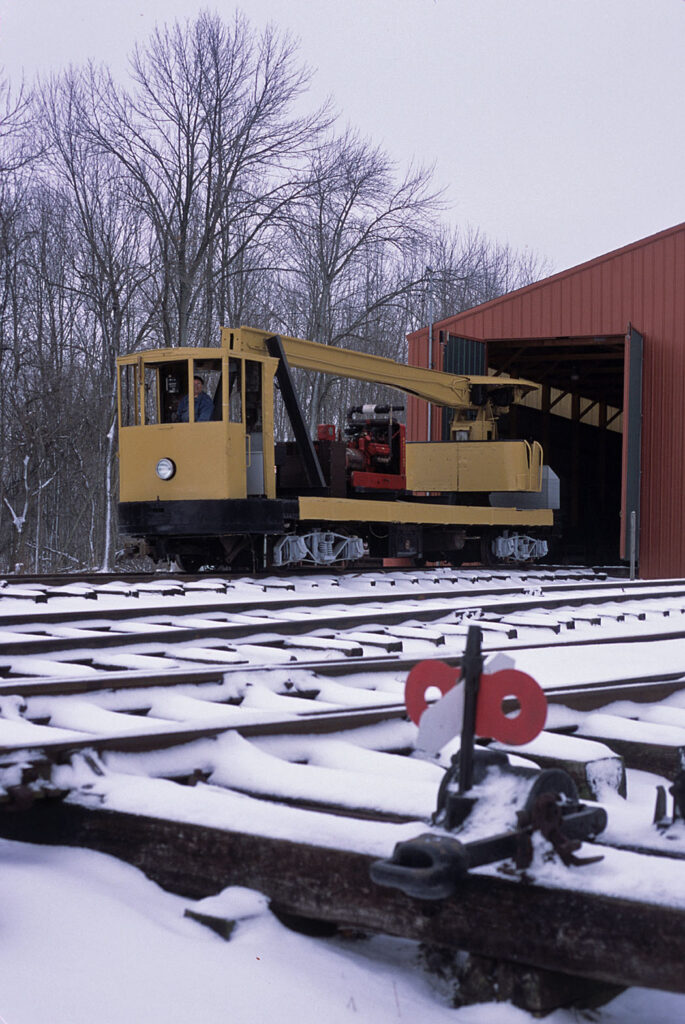
In addition to adding two new buildings and acquiring assets from two other railway museums, we did all the things we normally do in the 2000s. We either restored or started restoring several cars. These included our Cleveland Railway crane 0711. It was brought back to life and given its own power source. This was about a five-year project completed by from two to six volunteers. Once completed it gave the museum a car that could be used as a locomotive to move just about anything else we have. PRR MofW boxcar 499309 was completely restored and became our Museum Store. Ohio Edison flat car 100 was restored as was our Buda speeder. Two other restoration projects were begun, C&O caboose 90960 and TTC Peter Witt 2778. The latter received extensive steel work before work was paused. Work to convert our Philadelphia & Reading railroad combine into a visitor center was started and then paused.
In addition to the rail cars acquired from Grand Rapids and the Lake Shore groups, three other cars were acquired. CTS Airporter 161, Lake Shore Electric 149 and Rio de Janeiro Traction Light and Power open car 1774. Airporter 161 was one of the original 1967 cars. LSE 149 is one of the two Niles cars that LSE extended from 50 feet to 60 feet. It is a restorable body that came with a pair of CTA trucks. The RJTL&P open car came as a body only. Five cars were disposed of: the remains of Pittsburgh Railway snow sweeper M-30, destroyed in the 1998 fire, were traded to another museum; Shaker PCC cars 49, 72, and 83 were scrapped, 81 was sold to a private collector. The pair of trucks from 49 were sold to the National Park Service.
A lot of track work was done, including the carbarn lead, tracks for the second carbarn and for the storage yard behind the second carbarn. Throughout the 2000s, cars from the south side of Buffham Road were brought over to the new property. Additional rail and parts were acquired from the Cleveland & Eastern Historical Society. As a result of the 2005 hurricane Katrina, we received a truck load of overhead parts from the New Orleans St. Charles line. We also acquired a trailer load of steel poles from the Pennsylvania Trolley Museum. Before Trolleyville moved out of its Olmsted Township location, we were able to remove quite a bit of overhead hardware.
Somewhere in the late 1980s the museum began holding an annual evening at Trolleyville. After Trolleyville moved to downtown Cleveland, we continued to hold an annual evening of trains at the Northeast Ohio Live Steamers in Lester, Ohio. Media Nights were offered the first Friday of each month, annual picnics were offered each summer and annual meeting each spring. Throughout the decade we attended many train shows and had displays on the trolley deck of the Veterans Memorial Bridge (formerly the Detroit-Superior Bridge).
The 2000s had several firsts. We did our first guided tours of the museum; our archive was established, as was our endowment fund. With so much happening in the 2000s, I don’t think I can put my finger on the most significant thing to occur in the 2000s. I think the entire decade was significan.
| By the Numbers | 2009 |
|---|---|
| Members | 179 |
| Cars/Carbodies | 51 |
| Land (acres) | 40 |
| Track (total) | 7400 feet |
| Track (operating) | 0 |
| Overhead Wire | 0 |
| Buildings (permanent) | 3 |
| Net Worth | $517,795 |