by Walt Stoner
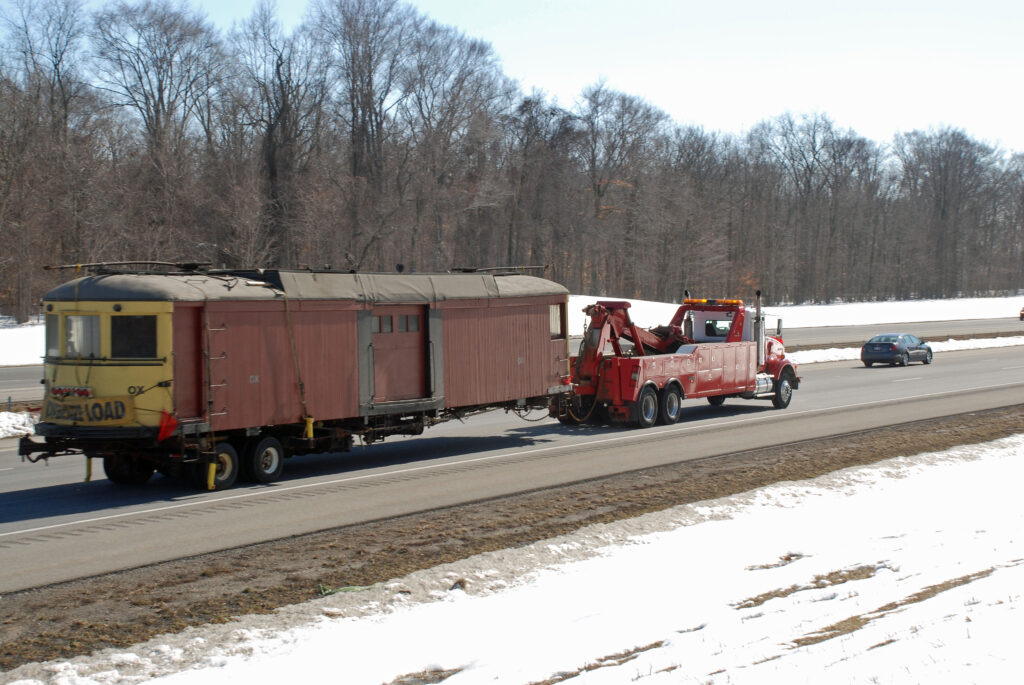
The first task of 2010 was the move of the last car we acquired from Trolleyville, Shaker Heights Rapid Transit freight motor/line car, 0X. It had been stored under the Terminal Tower since it was moved from Trolleyville in 2007. RTA moved it to Brookpark yard for us and it was ready to be moved to the Museum. We moved the car using tow trucks and a dolly. On the first day we took the car into the shop building and disconnected the motors. Then back out to the yard where a very large tow truck lifted one end of the car. The truck for that end was pulled out and replaced with a dolly. On the second day, the other end of the car was connected to a tow truck, lifted and the second truck pulled out. The car was now ready for the road. The two trucks were loaded onto a flatbed trailer that followed the car body. After a rather uneventful trip down I-71, the car body was pulled onto the Museum’s unloading track. The front truck was set on the rails, and the tow truck did some fancy maneuvering over the truck. The tow truck then set the car body back down on its truck. The following day, the tow truck came back, and the dolly was replaced by the car’s second truck. 0X was now on N.O.R.M. track.
In 2011, Shaker Height Rapid Transit’s first line car, 101, was purchased from Ohio Railway Museum. In a far less dramatic move, we had Silk Road, with their drive on/drive off trailer, make the move up I-71. 101, too, was soon on N.O.R.M. track. Back in the late 1950s and early 1960s, when 0X and 101 were both on the Shaker Rapid, the two were often coupled together to do track and overhead work. 101 had only one working motor, so it would be towed to the work site by 0X. Once there, 101 could move itself around the work area on its own but did not have enough power to keep up with revenue cars, so it had to be towed by 0X. Now both cars were on N.O.R.M. track.
As the decade began, plans were made to get our first car running under wire. We had this giant museum kit—all we needed was to put it together. The plan included finishing the restoration of Shaker 303, bringing about 1,000 feet of track up to operating quality, erecting overhead on that track, and making Cleveland Railway crane 0711 weatherproof. We would use the motor/generator/rectifier on 0711 to generate the 600-volt DC power we needed to run 303, use the pole on 0711 to put that power into the overhead wire, then run 303 back and forth on the newly renewed track. The plan was to get all this done in a year.

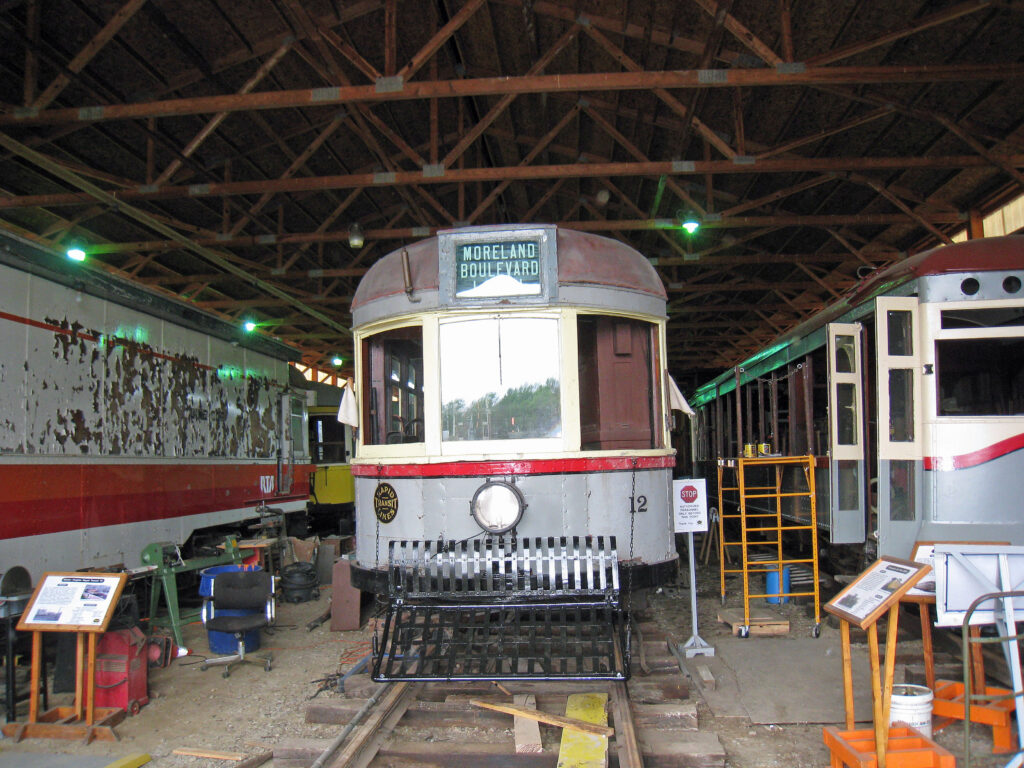
The plan was doomed from the start. But we got a little boost from RTA. In 2013 they donated three operating cars to the Museum: Shaker car 12, CTS rapid transit car 109 and line car 024. Car 12 immediately replaced car 303 in the plan. Even with a better car, the plan still took five years to complete. At the members’ picnic in 2016, the track and overhead were complete. 0711 had undergone a complete cab restoration, and car 12 had been completely gone over. On the day of the picnic, 0711 towed 12 out to the loading platform, then ran down to the end of the line and put its pole up on the wire. All we had to do was put 12’s pole up and see if it would run. Well, I had the pleasure of putting 12’s pole up and to my surprise it came to life. The lights went on, the compressor started chugging away, and the controller was calling my name. I ran Shaker 12 for several trips that day. We had some problems with the brakes, but these were soon fixed.
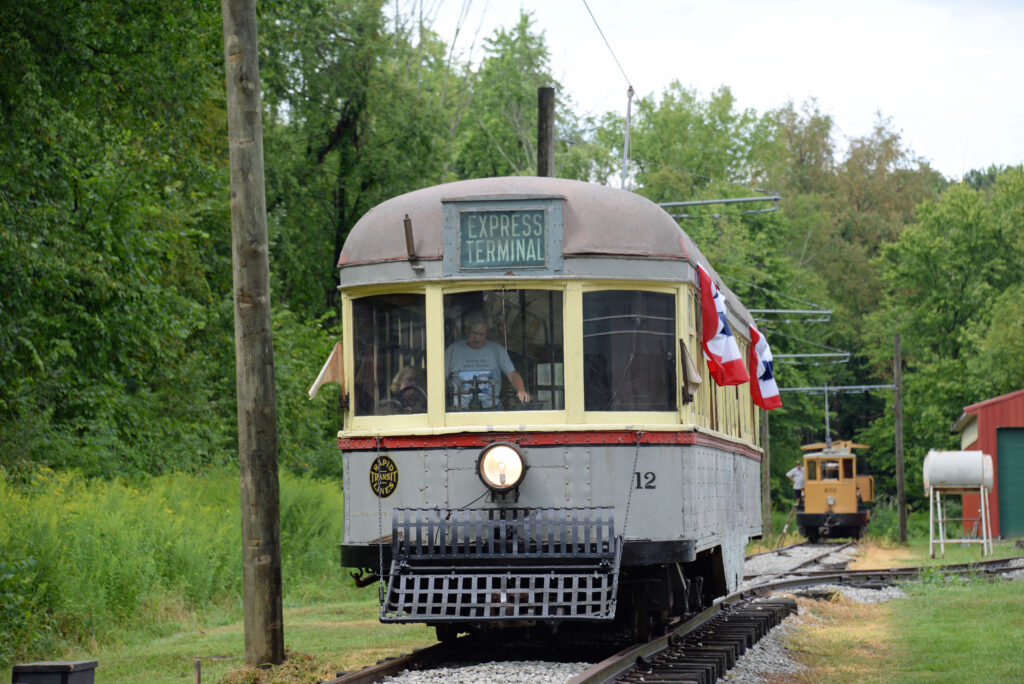
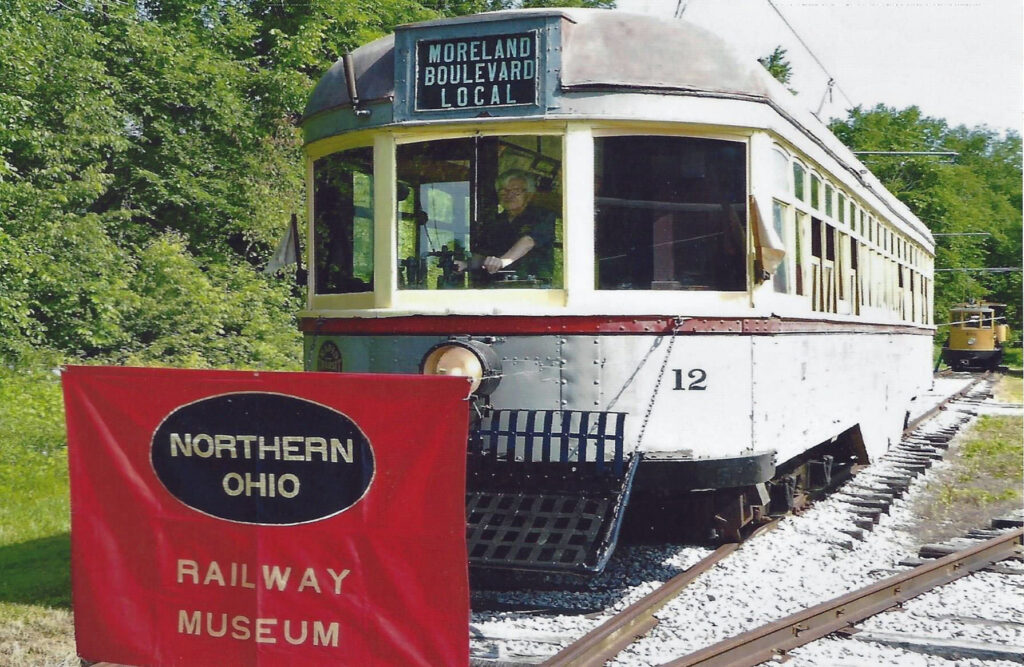
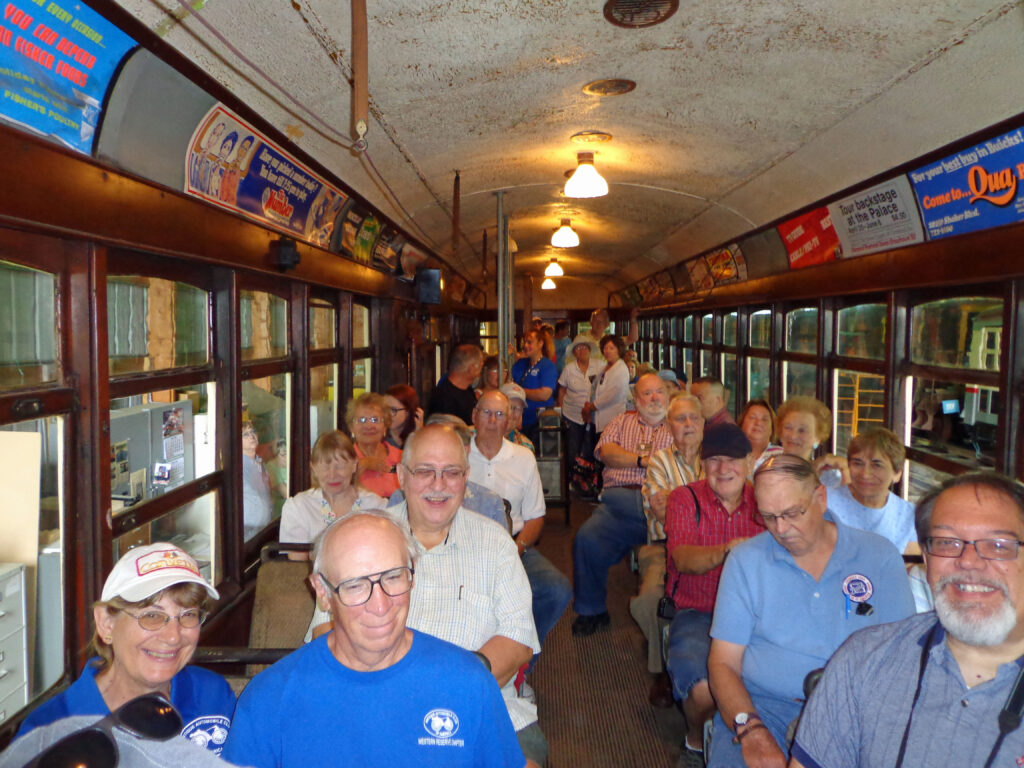
Running 12 that day gave us all a taste of what streetcar operation at N.O.R.M. could be like. We spent the next year fine tuning our plan for operation and officially began monthly operating days on June 10, 2017. By 2018 we were running two days a month. By 2019 an additional 800 feet of track was brought up to operating quality and overhead installed. In 2019, with funds from the 20th Century Electric Railway Foundation, a new substation was built providing power from our local electric provider, Ohio Edison. Our mission statement states that our goals are to collect, preserve, restore, display and operate, streetcars and other electric railway equipment for the education and entertainment of the public. We had finally attained our final goal: operation.
In addition to the cars mentioned above, during the 2010s the Museum also acquired a streetcar trailer and two non-streetcar vehicles. The trailer was Cleveland Railway/Shaker trailer 2318. It is one of only two remaining trailers of the hundreds that made Cleveland streetcar operation so unique. During most of its lifetime, it was pulled by a power car to make up what was known as a trailer train. It spent its last years on the Shaker Rapid. The first of the two non-streetcars was a ten-ton Plymouth diesel locomotive donated by Holcim (US) Inc. The locomotive worked at Holcim’s facility off Granger Road in Independence, within sight of I-77. Here railroad hopper cars of cement were switched into a facility that transferred the cement into trucks for shipment to concrete batch plants all over northern Ohio. The other was a model TM5 Trackmobile donated by Charter Steel Company. The TM5 replaced the Museum’s old model TM2. The TM2 was purchased by Trackmobile for display in their headquarters in Georgia. Having the Plymouth and TM5 on the property has made car moves much simpler. Also acquired were a frame and trucks from a burned-out caboose that was once part of Chippewa Lake Park.
Car work in this decade included preparing Shaker Rapid car 12 for service. Line car 024 also saw a lot of work to make it runnable again. It has been used to erect all of the Museum’s overhead wire. Cleveland Railway crane 0711 saw a major rebuilding of its cab. Its windows, doors and roof were all replaced. The Plymouth locomotive was completely gone over after it arrived. It was found to be in pretty good condition and only needed the engine serviced, new brake shoes and a paint job. Restoration of Shaker Rapid car 303 continued, even after car 12 arrived.
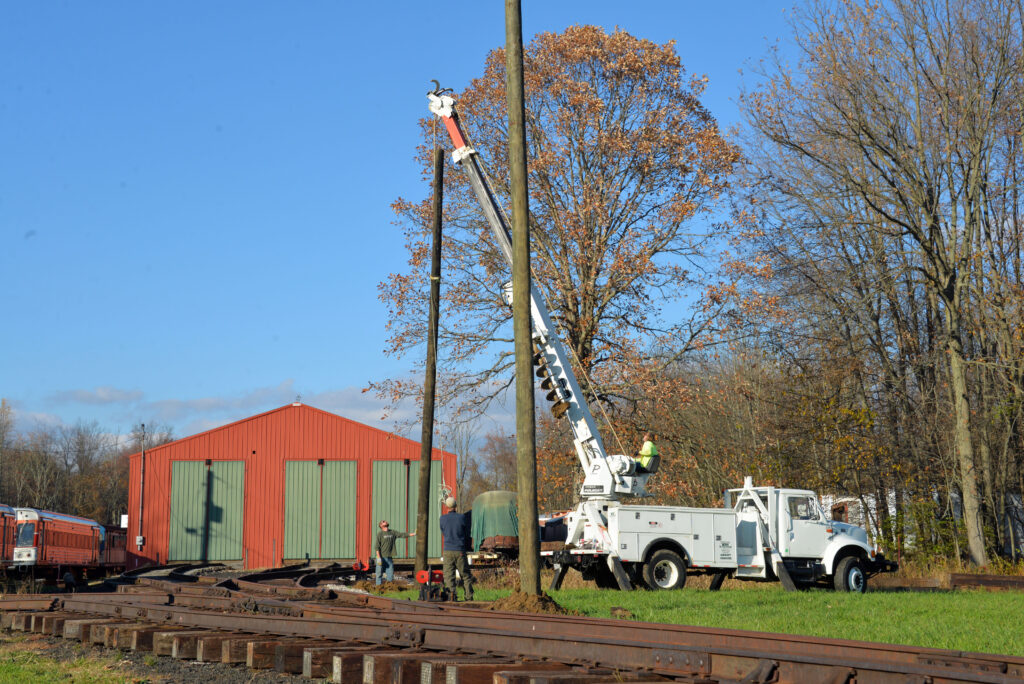
During this decade, about 1,800 feet of track was brought up to operating quality. It started with the 1,000 feet of the west loop track that was made ready for the initial operation then another 800 feet across the front field. Ties in the carbarn lead were also replaced. Overhead work began in 2013 with poles set along the west loop track. By 2016, this section was complete, and work began on the track across the field.
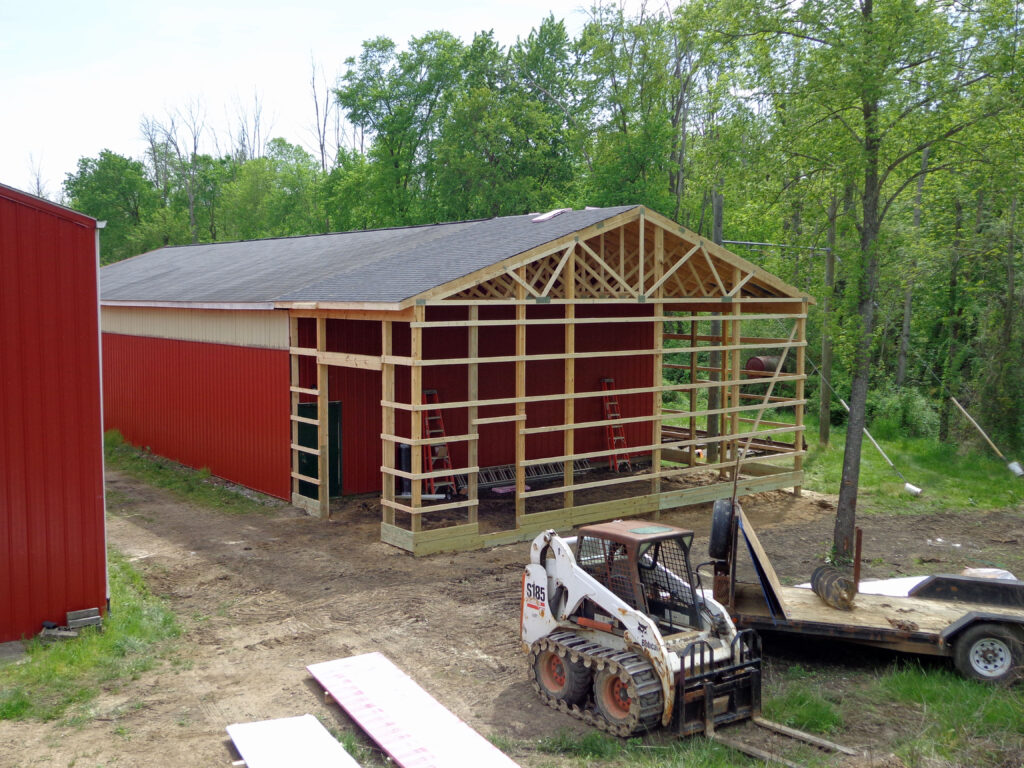
A couple administrative items of interest were the establishment of a permanent endowment fund at Akron Community Foundation in 2014. In 2017 the mortgage on the second carbarn was paid off leaving the Museum debt free (It still is today!!). In 2013 an eight-acre parcel of land just north of our main property was purchased. Together the two properties, plus a portion of the Cleveland Southwestern right-of-way, give the Museum a 40-acre main campus that runs from Buffham Road north to Kennard Road and east to the CSX track. In 2018 another fifteen acres were purchased north of Kennard Road for future development. In 2018 the maintenance building was extended by sixteen feet to accommodate a sub-station room. The remainder of the addition has been used as a meeting room, a classroom and a theater. In 2014 the Museum’s main entrance was developed, giving the Museum a public entrance for visitors and a service entrance.
Over the years a number of significant collections of photos, books and other artifacts have been acquired. These were generally stored at the homes of directors and other key people. In the mid-2010s, the Museum began renting an environmentally controlled storage facility for an archive. Shelving for both books and boxes were installed, and all of the collections were eventually moved to the storage facility. We still rent this facility and now have over 100,000 images and over a thousand books at the archive.
The 2010s were certainly a time of change for the Museum. We went from a static Museum at the beginning of the decade to an operating Museum at the end. For that reason, what I consider the most significant event of the 2010s occurred on June 10, 2017 when the Museum made its first streetcar run for the public.
| By the Numbers | 2025 |
|---|---|
| Members | 160 |
| Cars/Carbodies | 56 |
| Land (acres) | 63 |
| Track (total) | 7700 feet |
| Track (operating) | 1800 feet |
| Overhead Wire | 1800 feet |
| Buildings (permanent) | 3 |
| Net Worth | $1,046,518 |