
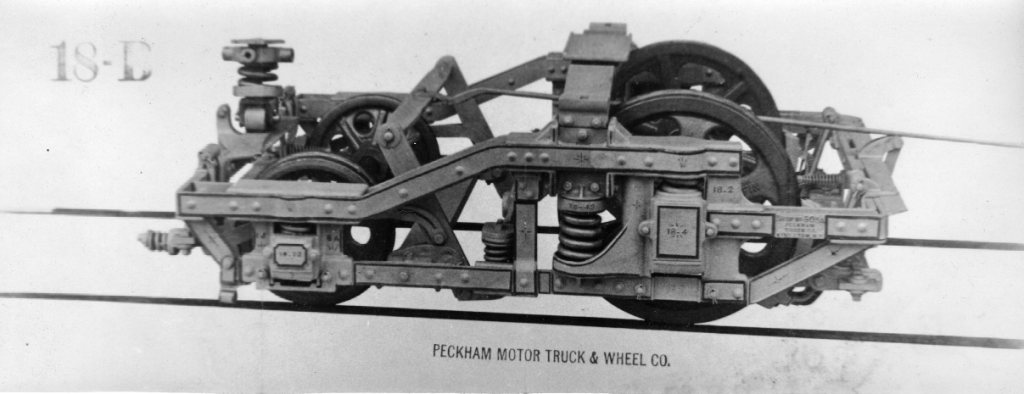
The Maximum Traction Truck. As we have discussed, the special needs of streetcar systems sometimes led to equipment different from that found on steam railroads. One such piece of equipment was the so-called “maximum traction truck.”
Because streetcars tended to be fairly light, they often had rather poor traction, making it desirable to have as much of the car’s weight as possible on the wheels that were powered. The earlier cars had two motors and a single two-axel, four-wheel truck. Having two motors, each driving one axel, all of the wheels were powered, so that the entire weight of the car rested on powered wheels.
However, as cars became longer, the single four-wheel truck was replaced by a pair of four-wheel swiveling trucks. If the car was given four motors, all axels still would have been powered. But, as was often the case, a two-truck, eight wheeled car was given only two motors, one on each truck, leaving two axels unpowered. In this arrangement, with only half of the weight of a car carried by powered wheels, traction became more of problem.
The attempted solution to this problem was through an arrangement to shift more of the weight of the car onto the powered wheels, hence the term “maximum traction.” The ordinary swiveling four wheeled railroad truck has the weight of the car supported on its middle, thereby placing weight equally on all wheels. However, by shifting the weight toward the end of the truck carrying the powered wheels, more weight is transferred to those wheels. The unpowered wheels then served largely to guide the truck on the track, and often were made smaller.
Although very popular for some years, it’s questionable how much this type of truck actually improved traction. Furthermore, because the unpowered wheels carried very little weight, they tended to derail. Finally, in order to increase the speed and hauling power of the cars, double truck cars were given four motors, thus powering all eight wheels and eliminating the need for the maximum traction truck.
Picture, Trolley Museum of New York (TMNY), shows how the weight of the car was carried as close as possible to the powered wheels. TMNY, located in Kingston NY, is well worth a visit, weekends and holidays, late Apr to late Oct.