The Vision of O.C. Barber
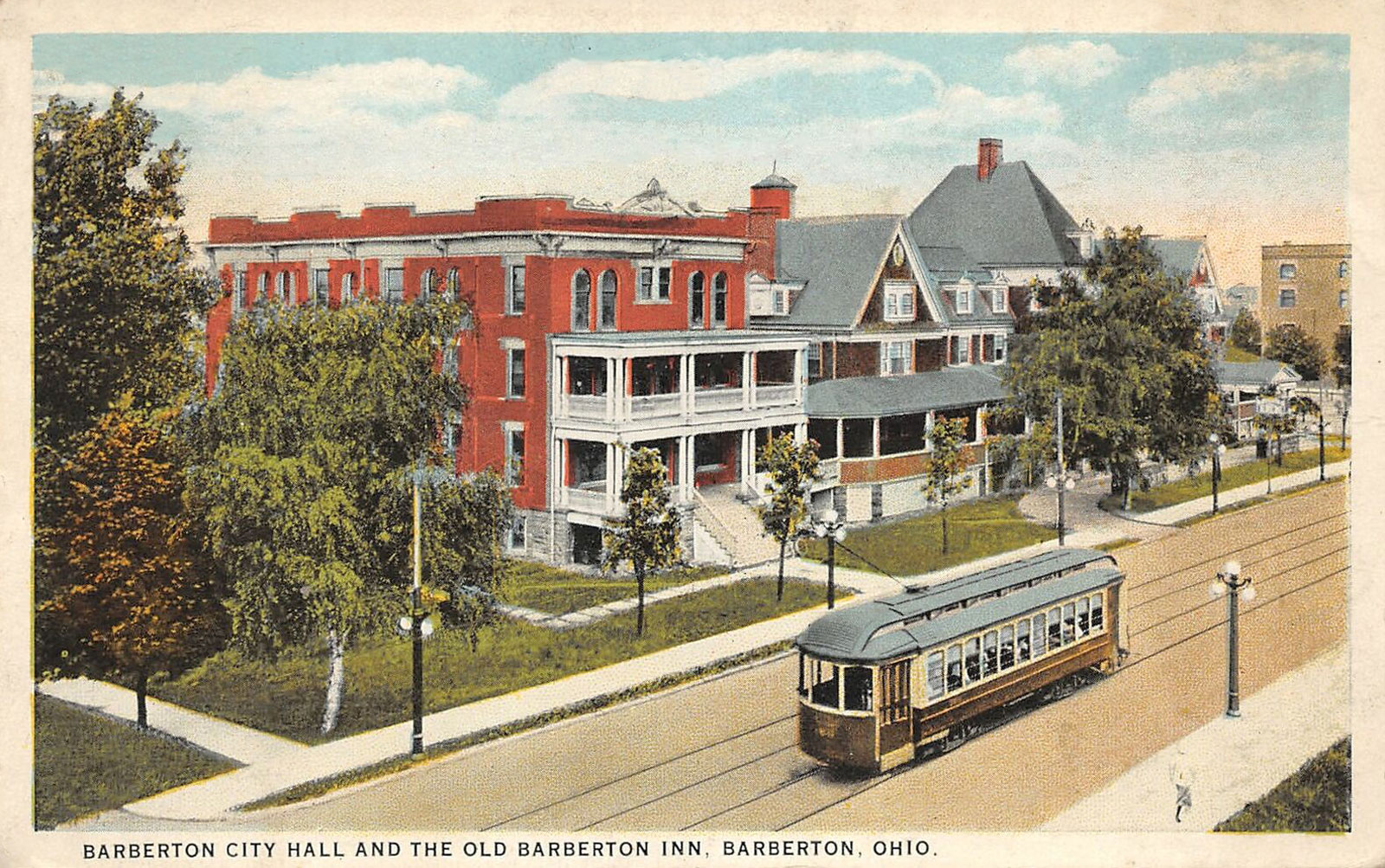
Barberton is located to the south west of Akron. It was founded in 1891 when O.C. Barber, founder of the Diamond Match Co., located his factory at an undeveloped site and built a town to house his employees.
This was not to be the classic “company town,” a money-making proposition for the company, but a full scale city, containing industrial, business and residential districts, and with educational and recreational opportunities.

It was incorporated with a population of 1,800. This was at a time when large numbers of immigrants were entering the US, and many were attracted to Barberton’s employment opportunities. By 1900 the population had reached 4,354, by 1910 it was at 9,410 and, by 1920, 18,811. It was from this development in 30 years from open farm land to a significant city that it came to be known as “The Magic City.”
Early Competition Between A&CFRT and NOT&L
But, how did people get there? The town was located on the Erie RR, but this didn’t provide good local transportation. So, trolleys weren’t long in arriving. The Akron and Cuyahoga Falls Rapid Transit Co. (A&CFRT) reached Barberton in 1895. By 1900, rival Northern Ohio Traction and Light Co. (NOT&L) was also building a line. In early 1901, NOT&L gained control of A&CFRT, by that summer had completed its own Barberton line, and the earlier line was mostly abandoned.

The NOT&L line ran from the end of its S. Main St. route, along Kenmore Blvd. and Wooster Rd. where it contributed to the development of Akron’s Kenmore neighborhood. Upon entering Barberton, the line made use of the tracks of the earlier company, following Lake Ave., 2nd St and Tuscarawas Ave. From 1907 – 1934, the line continued on west to Wadsworth. During this period, the line was operated separately from the Akron city lines, although service frequency to Barberton was that of a city operation
The Final Days of the Barberton Streetcar
With the breakup of NOT&L in 1930, service was continued by Akron Transportation Co., which operated it after 1932 as part of the city system. It remained during the WW2 period as one of two remaining Akron streetcar lines, finally ending on 19 May, 1946, 10 months before the final end of Akron streetcars.

The Enduring Blueprint of the Magic City
The influence of the Magic City’s rapid expansion remains visible in its modern geography. Barberton was built on a foundation of connectivity. The path established by the NOT&L defined the development of this entire corridor. It stretched from the heart of Akron through the Kenmore neighborhood and into the industrial pulse of Barberton. Today, drivers on Kenmore Boulevard follow the same transit spine that transformed open farmland into an urban center. Barberton is a testament to the vision of O.C. Barber.
Visit the Northern Ohio Railway Museum in Seville
Many of the stories we share here at the Northern Ohio Railway Museum are preserved not just in photos, but in the historic cars within our collection. Our volunteers are currently working behind the scenes in Seville to prepare these treasures for our upcoming season.
We invite you to join us for our 2026 Opening Day on May 23 to see history in motion and experience an authentic trolley ride for yourself. In the meantime, feel free to explore our full collection online or check out our upcoming events.