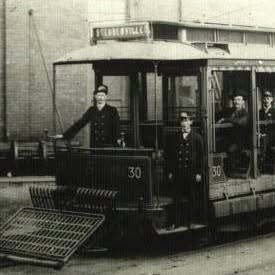
The introduction of electric power greatly increased the ability to move a vehicle. But, don’t you know, it also was necessary to make it stop – and to do so when and where desired. Because steam railroads had been operating for a number of years before street railways became common, braking systems had been developed that readily transferred to horse cars and, later, to the electrics.
The braking arrangements developed for the steam roads consisted of cast iron brakes. These were faced with replaceable brake shoes made of a softer material, typically wood, that provided better braking through increased friction and that also reduced wear, both on the wheels and on the brakes. These brakes were made so as to press on the wheel tread.
On a street railway car, brakes were applied by means of a “goose neck” lever at the top of a vertical shaft extending below the floor of the car. At the bottom of this shaft was a wheel attached to a chain connected to the brake mechanism. When this wheel was turned it tightened the chain and, using leverage, applied the brakes. Ordinarily, the vertical shaft also had a rachet so that, when the brakes were applied, they could be held without further effort. Incidentally, in steam railroad practice, a wheel was used rather than the “goose neck.”
On the electric cars, this braking system was usable, but it was less effective than on the lighter, slower horse cars that had a husky, well trained team of horses to help. It required considerable strength on the part of the car operator, and sometimes was insufficient, leading to accidents.